ABOUT
Fifteen years at sea,
and everything that came after
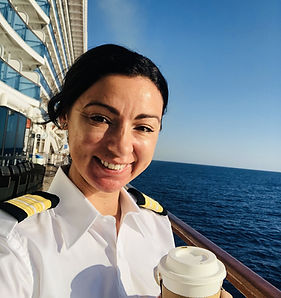
Sara Romera is a former senior cruise ship officer, writer, and creative director. She spent more than fifteen years working at sea, rising to senior operational roles across multiple vessels and cruise lines.
She is the author of Inside the Floating City, The Discerning Voyager, the Love and Other Ports series and The Lantern of the Sea, and writes the monthly Ask the Officer column for Euro Weekly News. Her creative work includes the destination immersion program Mare Nostrum and the produced port-talk format Destination Theater, developed for cruise lines and luxury operators.
She now writes, designs onboard experiences, and creates from a home in Malaga, Spain,
-
Former Senior Cruise Ship Officer
-
15+ Years Operational Experience
-
Circumnavigated the Globe · Twice
-
Author · Five Published Books
-
Columnist, Euro Weekly News
THE BACKGROUND
I didn't read about how
these ships work. I lived them.
Over fifteen years at sea, I rose from entry level to senior officer roles across some of the world's most recognized cruise lines. I led teams of more than seventy nationalities and oversaw end-to-end guest operations including Rooms Division, Entertainment and Events, cultural programs, guest relations, and onboard media.
I sailed routes across the Mediterranean, the Atlantic, the Pacific, and beyond. I stood on the pontoon during tender operations in difficult conditions, managed guest flow on ships carrying thousands of passengers, and saw first-hand what happens when an itinerary meets reality.
I have also been in the parts of the ship that passengers never see. The operational spaces, the crew corridors, the decision-making rooms where what you experience as a guest is quietly determined long before you board. Most people who write or advise about cruising have seen these ships from the guest side. I grew through the ranks of the operation itself, which means I know not just what the experience looks like but why it happens the way it does. I read thousands of feedback surveys. I dealt with the complaints, the recurring problems, the patterns that repeat sailing after sailing. That knowledge doesn't come from being a passenger. It comes from being responsible for the operation.
The first international crews I lived among were children. I grew up on the Costa del Sol and attended an international school there, spending my childhood among classmates from every corner of the world. That early exposure shaped how I would later lead crews of seventy nationalities at sea, and it shaped how I think about hospitality. What one culture reads as warmth, another reads as intrusion. What one guest experiences as attentive service, another experiences as being watched. Real hospitality begins with never assuming what comfort means for the person in front of you.
"Fifteen years of other people's complaints teaches you one thing. The truth about a sailing is more useful than a comfortable answer."
I spent years reading what passengers couldn't say clearly. Reviews are personal accounts of operational realities, and knowing how ships work changes what you hear in them.
A complaint about slow service on a sea-day-heavy itinerary is a scheduling signal.
A port that felt too far away is almost always a berth and ship-size issue that was predictable before anyone boarded.
Guests who found an itinerary underwhelming often hadn't been given a way into its stories, they'd been given information without immersion.
A production show had to be cancelled because it had been designed without a proper re-block plan, and a single cast injury or illness made the whole thing impossible to run last-minute.
Small things, all of them, and every one predictable from the inside. That ability to read beneath the surface of what people report is what shapes everything I now write, design and build.
THE WORK NOW
I write about what I know,
because I wish someone had.
I treasure cruises. I feel energised and fulfilled by the operational marvel of them and the way a well-designed voyage can move people. And I have watched, over and over, the small failures that turn what should be a beautiful experience into a lesser one. A cabin location that was wrong for the guest. A shore excursion that was oversold. A destination speaker who didn't do the port justice. A crew member who had never been given the tools to thrive at their first contract.
These are rarely accidents. They are patterns, and they are fixable. So I write about them, and I build around them.
Inside the Floating City began as a survival guide I wrote for new crew, because I remembered how hard the first contract is. The Discerning Voyager exists because too many people spend the one thing you cannot get back, time, on a ship that was never right for them. The Lantern of the Sea was written for the families ashore, because I have seen the faces of my colleagues who missed their children, and I wanted those children to know their mother or father was a hero. Love and Other Ports is where I finally let myself write the world the way I always saw it, romantic, devoted, and larger than life. Mare Nostrum, Into the Horizon, and Destination Theater are the creative expression of what I saw work, and what I saw fail, on the entertainment side of the operation. All of it comes from the same place.
My hope is for voyages to move people the way they've moved me. And for the people who take them, and the people who work them, to be seen properly, before, during, and after.
PUBLISHED WORK
Books from a life at sea,
written for everyone who calls it home,
for a week or a career

Most cruise complaints come down to one thing: the wrong ship for the wrong person. A senior officer's guide to choosing well, so guests get the voyage they hoped for, and the crew get the happy guest they're working for.

It began as a survival guide for new crew, and grew into something more: a guide for those who work at sea, and a window for travelers into the real life of the ship beneath them.
"Ships quenched my spirit on the days it was hungry.
The people in them built my character.
All I write, plan, and design
is my small way of giving back."
For enquiries, partnerships, or press: contact@sararomera.com